Elin Gunnarsson
|Always-On Communications
|2026-09-23|4 min
We went to CASA26 with a story to tell. Not a features list, not a roadmap update — a story about who ends up owning the next twenty years of business communications, and why that answer isn't decided yet.
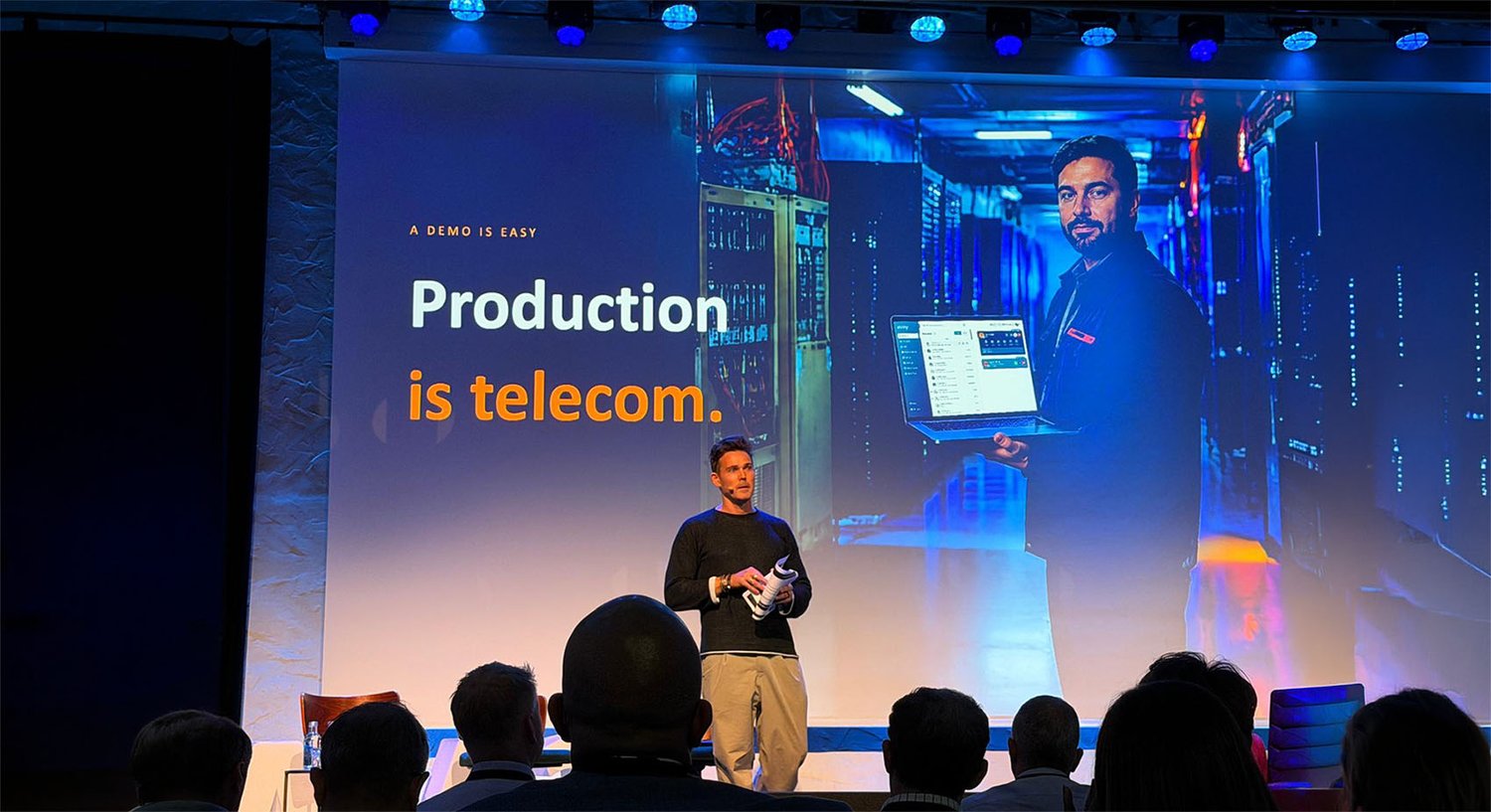
Our Co-Founder and Group CEO, Daan De Wever, opened his keynote — Commercialising Sovereign AI Communications — with a simple prop: an invoice. AI services, billed monthly. Line items for a voice agent working after hours, call summaries, requests captured, customer context. One field left blank. Provider: whose name goes here?
Every business is about to buy an AI. The only open question is who sends the bill.
Telecom operators funded the spectrum, the fibre, the numbering, the resilience — the infrastructure the entire industry still runs on. Somebody else built the interface on top of it. Somebody else captured the attention, the data, and most of the revenue that showed up as a result. UCaaS and contact centre clawed back some ground, but those markets have matured, and margins came down with them.
AI is threatening to run the same play. An agent can sit between a business and every conversation it has, capturing the value while the network underneath does the invisible, expensive work of actually connecting the call.
Daan put it plainly: you can remain essential, and still become invisible. Electricity powers the room, but nobody thanks the power company for the lightbulb. Networks are staring down the same fate — indispensable, and unbilled.
There's a second shift buried inside the first one. The next participant showing up on an operator's network may have a phone number and no lunch break. AI agents book appointments, update systems, and increasingly talk to other agents. They need identity, policy, and someone accountable for what they do — and when a conversation needs judgement or empathy, the handover to a human has to happen without losing the thread.
Voice isn't going away. It's becoming the interface AI uses to get things done.
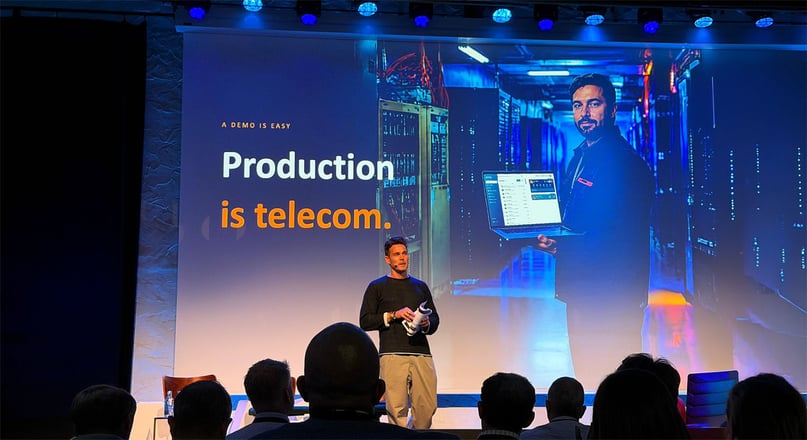
Here's the line that landed hardest in the room: the gap everyone's worried about isn't AI capability. It's commercialization.
Anyone with a model, a speech API, and a weekend can build something that impresses a room. What a demo skips — provisioning, consent, billing, failure routing, audit trails — an operator service can't. That gap between "it works" and "we can sell it, support it, and bill for it" is where most AI launches stall for good.
Dstny calls this the Production Gap, and closing it was the actual subject of the keynote.
Our answer: the AI Commercialization Layer for Service Providers. Not a single product, but an overlay — Dstny Digital Agents, Conversational Intelligence, and analytics, sitting on top of the call control operators already run, provisioned, billed, and supported as one thing, under the operator's own brand.
No migration first. No waiting for a five-year network roadmap before the AI one gets to start. And built in Europe, not bolted onto it afterward — the data, the models, the policy, all auditable, all under the operator's own rules.
"Sovereignty is not a hosting location. It is operational control," Daan told the room, and it's worth unpacking, because most vendors stop at the first half of that sentence. Being EU-hosted is table stakes. The real question is who decides: where the data sits, which model runs, whose policy governs a call, and who's accountable when something goes wrong.
Dstny's answer covers all of it. Data stored and processed in Europe. Identity - the numbers, the subscribers - stays the operator's. Models are the operator's choice, hosted where they say. Policy is the operator's rules, auditable. Deployment can run on Dstny's cloud, the operator's own, or on-site. And the people building and running it are based in Europe, not just the servers.
That's the difference between sovereignty as a checkbox and sovereignty as a commercial position. With data residency becoming the first thing regulated customers ask about, before price, it isn't a compliance footnote anymore... It's the pitch.
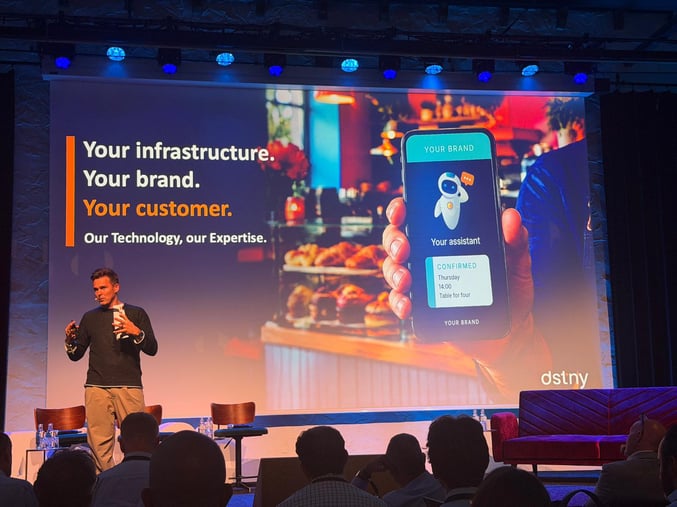
That's how Daan closed it, and it's worth sitting with. Always-On Communications was the promise we made in June — that no business conversation should ever be missed. The AI Commercialization Layer is the mechanism: how a promise about always answering the phone turns into an operator-owned line of revenue, instead of someone else's.
Every business is about to get an AI. We came to CASA26 to make sure it comes from you.
Book a call with a Dstny representative →