Why old antennas fail quietly and what it means for your operation.
Most telephony issues in warehouses don’t start with a crash or a sudden failure.
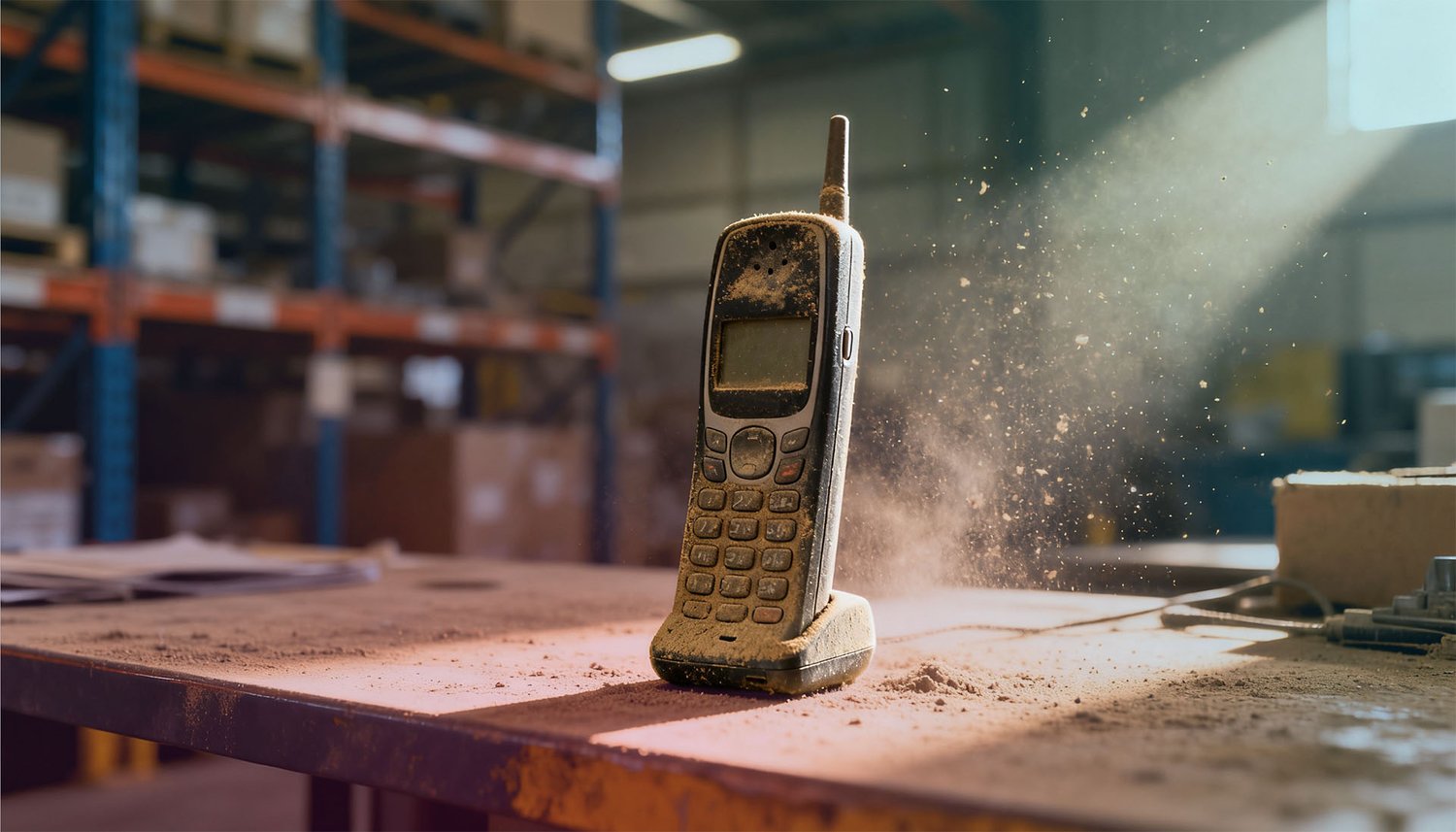
They begin quietly, with something as ordinary as dust settling on a DECT antenna that has been positioned in the same place for a decade. A quiet saboteur that lours inside many warehouse.
Over time, that thin, harmless-looking layer becomes a slow killer of coverage, call quality and reliability.
DECT systems was not built for a decade of dust and vibrations
DECT setups earned its place in warehouses for good reason. It was simple, reliable, predictable. But none of that changes the fact that many DECT setups in warehouses today have been running for 10, 12, even 15 years.
And a lot has changed in that time. Buildings expand, old machinery gets replaced with new ones, teams grow larger, warehouse layouts changes…and dust settles everywhere.
Including inside antennas, chargers, and handsets.
Dust isn’t just cosmetic. Over time, it clogs ventilation, traps heat, interferes with electronics and degrades signal quality. Combine that with natural hardware aging and 24/7 warehouse vibrations, and you end up with outdated DECT systems that are trying their best… but simply can’t keep up.
How dust quietly kills DECT, without anyone noticing (at first)
It usually doesn’t start with a dramatic failure. It starts with small things like a handset that drops calls in the same aisle every day, an antenna that overheats and resets itself quietly, a charger that stops making proper contact and coverage that used to be strong but now feels “patchy”.
No alarms or flashing error messages. Just slow, creeping unreliability. The kind that warehouse teams notice, long before anyone can explain it.
And because dust-related degradation is gradual, companies end up living with the symptoms much longer than they should.
The real cost lies in the delays it creates
A forklift driver trying to reach planning or a picker calling for stock confirmation.
A maintenance technician responding to a breakdown, and a shift lead trying to coordinate overtime.
When communication lags, the operation lags.
And the dust collecting on old DECT systems becomes more than a housekeeping problem. It becomes a productivity problem. One that spreads across planning, stock accuracy, maintenance response times, internal coordination and customer updates.
Why cleaning isn’t a fix, and a same-for-same replacment isn’t a long-term solution
You can clean a DECT antenna and blow dust out of a handset. You can even replace a faulty base station. But the bigger problem remains; many DECT ecosystem is aging out.
Spare parts are harder to find. Support is decreasing. Coverage is inconsistent.
And replacing one part often reveals three other components that are just as old.
The truth is: dust is only the symptom. Aging DECT infrastructure is the real issue.
A modern alternative – a mobile-first approach
Today’s warehouse workers depend on mobility more than ever. Modern communication needs to reflect that.
That’s why so many warehouse environments are switching to:
- industrial-grade smartphones
- mobile-first communication platforms
- signal repeaters that outperform old DECT antennas
- strong indoor coverage supported by boosters
- one device for both fixed and mobile calls
- integrated apps for planning, ERP, CRM and more
A simple takeaway
Dust might be the visible sign, but more importantly, it’s a sign of a bigger problem. If your old DECT system is slowing down, dropping calls or becoming unreliable, the problem isn’t your cleaning schedule, it’s the limitations of old infrastructure in a modern, mobile, high-demand warehouse.
And for warehouses running on tight schedules, that kind of communication break downs can cost a lot in the end.