

Joshua Moynehan
|Blog
|2026-01-12|7 min
At the end of last year it was revealed that Microsoft Teams Phone had crossed 26 million users. An impressive number in itself, especially seeing as it was a 30% increase in seats since their last report which showed up in one of Microsoft’s earnings call in 2024.
But so what?
What makes the mighty Microsoft Teams so special just because they’ve added a voice-enabled userbase the size of Singapore across the last year or so? As great as “26 by ’26” sounds (Microsoft you can use that one, on me), what are the actual implications of this growth for providers who are in, around or circling the Teams space?
The crucial thing you need to get your head around is that this isn’t Microsoft waving the chequered flag, lifting a trophy and calling it a day. In fact, there is a far more important number that has come out of these recent announcements, and it isn’t in the millions, thousands or even hundreds.
Six. That’s the number providers should be more focused on. Just 6% of the overall Teams userbase is voice enabled, highlighting both how much uptake is still possible based on the current Microsoft Teams seats alone and the public support that Teams has as a platform. An oversimplification of course, but even if Teams didn’t add another seat, that’s still a TAM of around 294 million for a service that you can run as a part of your whole service.
This isn’t even the whole picture – As more hurdles for full-scale Teams Phone adoption get crossed, and as Teams gets more functionality outside of calling, the opportunity for CSPs and MSPs is growing month on month in a number of different ways.
Of course, you could look at that six percent from a couple of different angles. Teams Phone has been going for a while now and seeing this relatively slow uptake could make voice enabling Teams seem a non-starter for providers looking to drive revenue from the world’s most popular work app.
On the other side of that coin however, is a much more hopeful picture and it’s hopefully why you’re here.
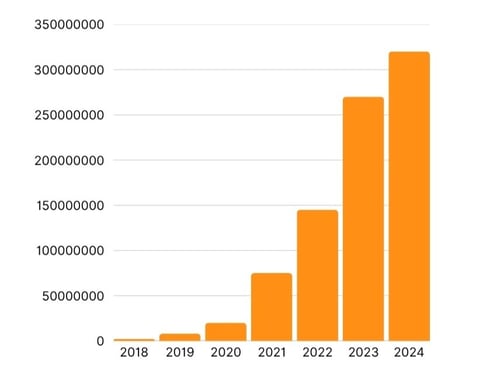
Teams is Microsoft’s most popular app to date, why? Because of a sudden need for remote business communications? Because it was (somewhat aggressively) bundled into various Microsoft packages? Right place right time? All of the above? One thing that’s clear is that as the hybrid model leapfrogged into being the predominant way of work for many, the amount of people using Microsoft Teams just kept on growing beside it. From less than 8 million users in 2019 to 270 million by the end of 2023, now sitting around 320 million MAU.
Now let’s flip this on its head and change focus a bit – Here’s a telephony platform that’s grown by over 26 million users in just a few years using mainly third-party voice services. This platform is still adding major releases like Frontline Hub which caters to the massively underserved deskless workforce, has firmly cemented itself as a go-to- solution for businesses large and small and has averaged a growth of 300,000 per month for the past 20 months. Oh and they also do a bit of collaboration tooling on the side.
Communications and IT have been circling ever closer to each other over the past few years, to the point where they’re now practically touching but they still get adopted by businesses in very different ways - IT apps grow rapidly and spread a thin layer on top of workflows, communications creates deep roots that form the core of organization-wide processes.
Even without a legacy system in the way the laundry list of service-critical things that need to be checked off before you even get a Teams dial tone is still comparatively long and complex. But does this make Teams too tricky to drive revenue from or just tricky enough to differentiate you from everyone else who isn’t capable?
As various Teams Phone complications get increasingly smoothed out by early adopters, channels like Direct Routing and Operator Connect (especially when combined with services like Call2Teams) are getting increasingly better at enabling MSPs, CSPs and resellers to get voice into a userbase that is ready and waiting…Albeit at a bit of a slower pace than the solution that they’re built on top of. With these sorts of methods providers are actively using Microsoft to reduce churn, even if it means delivering their services in the form of a Teams-based softphone or UI.
Because of this, we can almost use the size and growth pattern of the Teams platform as a lagging indicator that the Teams voice market is far from its peak and the momentum is there for those that can add some much-needed capabilities on top of just a dialler.

As businesses are still trying to figure out their answer to the hybrid question, you need to start adjusting your strategy to suit the outcomes your customers need going forward. That means living in the platforms they’re already using instead of just trying to force them onto yours, but you don’t have to lose your edge, identity or long-term roadmap to do it.
It's true that you can no longer out-Teams Teams, but you don’t have to. This is because even as the C in UC grows in importance, Microsoft still aren’t looking to be the world’s biggest CSP, and that’s where your opportunity lies.
Just selling minutes in a new arena isn’t going to be enough for you to survive long-term, regardless of what flavour of Teams Phone you choose. Adding layers to what you can offer in a way that drives revenue with minimal complexity at maximum speed is going to be one of the biggest challenges for providers going forward both in and out of the Microsoft space this year.
Because of this, if you want to act as a successful voice system for Teams-forward orgs you also need to deliver on a lot of other aspects. From automated provisioning to analytics and call recording you now need a number of these layers to stay competitive.
On top of this you need to think about your mobility and AI plays and how all this fits in with the workflows and stacks that your customers are already using.
And then there’s the small task of making everything work together in a way that works for your customers.
With all of this in mind, to prevent overwhelming margin pressure and ultimate failure you only really need to focus on three things – Complexity, reliability and predictability.
Microsoft Teams Phone is behind the sprinters (including Microsoft Teams itself), but it’s nevertheless still heading for the same finish line. To take advantage of this you need to work with a partner who can ensure effective enablement, rapid time to market and quick time to revenue.
Dstny is your one stop shop for all things Microsoft Teams, so why not book a demo to see how Microsoft Teams Phone can work for you.